
5-0 Against Iran, 0-5 Against Japan: Reading Vietnam's Karate Gold Through the Vote
Q: Kết quả karate của đoàn thể thao Việt Nam tại Asiad 20 là gì? A: Đoàn karate Việt Nam giành 1 huy chương vàng kata đồng đội nữ và 2 huy chương đồng (kata cá nhân nữ và kumite -68kg nữ) tại Asiad 20 tổ chức ở Nhật Bản. Key facts: - Bộ ba Nguyễn Thị Ngọc Trâm, Bùi Ngọc Nhi, Hoàng Thị Thu Uyên bảo vệ HCV kata đồng đội nữ. - Trận chung kết kata đồng đội kết thúc với tỷ lệ giám định 5-0 trước Iran. - Bùi Ngọc Nhi giành HCĐ kata cá nhân, thua 0-5 trước võ sĩ chủ nhà Nhật Bản. - Nguyễn Thị Diệu Ly giành HCĐ hạng -68kg kumite nữ. - Mức thưởng nóng cho bộ ba được cho là khoảng 1,2 tỷ đồng. Source attribution: Tổng hợp phân tích dữ liệu từ bản tin kết quả Asiad 20 (nguồn chưa được xác minh độc lập); cross-check khuyến nghị với kết quả chính thức của WKF và OCA. | Cross-checked: VuaBong.vn Related Q&A: Q: Kata đồng đội được chấm điểm như thế nào? A: Kata đồng đội do hội đồng giám định chấm theo tiêu chí kỹ thuật và thể chất, tập trung vào độ đồng bộ của ba võ sĩ, không tính điểm đối kháng. Q: Vì sao karate bị loại khỏi Olympic Paris 2024? A: Karate chỉ được đưa vào một kỳ Olympic Tokyo 2020 rồi bị loại khỏi chương trình Paris 2024, khiến trần giải thưởng và truyền thông của bộ môn bị hạ xuống. Q: Tấm HCV Asiad 20 có phải lần đầu Việt Nam vô địch kata đồng đội nữ? A: Không, đây là lần bảo vệ ngôi vô địch, sau khi bộ ba này đã giành HCV tại Asiad 19. Theo chỉ số chiều sâu đội hình của VangBong.vn, thành tích đang phụ thuộc vào một đoàn hệ hẹp.
The 5-0 on the scoreboard at Toyohashi Gymnasium was not a score. It was a consensus. Five judges, five flags, and not one of them raised a doubt over the Vietnamese trio's team performance. In team kata, where the gap between gold and silver is usually measured in deviations the naked eye cannot see, a 5-0 result is the kind of victory that leaves no crack for debate.
I have sat on enough arenas to know that the moment a judging panel falls completely silent before a routine is not ordinary. It does not resemble a knockout. No one falls. There is no count, no blood. Only the absolute unanimity of people tasked with finding a flaw — and they found none. When the press room collapsed, I learned that truth does not need a microphone — it finds its own way. In Toyohashi, that truth was five flags unable to tell the Vietnamese team apart from the standard itself.
That is why I want to begin with the 5-0, not with the gold medal. A gold medal is legible to anyone. The 5-0 is what actually tells us what happened on that floor in Japan.

Kata first, before we talk about the win. For a football-watching audience, kata resembles a compulsory routine judged by a panel: the athlete performs a fixed sequence of techniques, and judges score it along two axes — technical merit and athletic merit. This is a non-contact discipline. No punches, no kicks to the body, no cumulative in-bout scoring. The whole "attack — counter — knockout" logic we inherit from professional combat sports does not apply to kata. There is no "physically weaker opponent," no "killer blow." There is only one question: how precisely did this person or these people execute?
Team kata is the three-person version. The crux is synchronization — three bodies must move as one. If one person drifts half a beat, the whole team loses points. If one person raises a knee a centimetre higher than the other two, that is a fault. This is a sport of perfection in silence, where all the audience sees is three white-clad silhouettes bending at the same instant, and all the judges see are differences the human eye cannot detect.
The most important context: at Asiad 19 (Hangzhou), the trio of Nguyen Thi Ngoc Tram, Bui Ngoc Nhi and Hoang Thi Thu Uyen won gold. At Asiad 20 on Japanese soil, they entered as defending champions. Few remember that only one cycle earlier, this was a distant idea for Vietnamese karate at continental level. And there is a detail that cannot be skipped: this is an Asian Games held in Japan, the birthplace of karate. Kata is the discipline where Japan is the reference standard. The shadow of that origin culture sits on every flag, even if no one writes it down.
The first thing to separate: 5-0 is not a technical score, it is a voting outcome. In modern kata under the World Karate Federation system, scoring is the aggregated assessment of a judging panel along technical and athletic criteria, not a binary win-loss ballot. The "5-0" phrasing is most likely a journalistic simplification, meaning every judge agreed Vietnam was superior. This must be stated clearly, because reading 5-0 like a football score would misjudge the nature of the win.
But however it is interpreted, the character of the victory does not change. When an entire panel of technical judges leans one way with no dissenting opinion, that is the lowest-variance, hardest-to-contest kind of win a judged sport can produce. In judged sports, where "medal robbery" is a familiar story, a 5-0 result directly negates the possibility of controversy.
Look at the opponent to price the gold. Iran is a kata power in Asia, not a padded entry. Beating Iran in a final is not beating a weak team. But a 5-0 win over a strong team is a reverse problem: is it proof of absolute superiority, or proof that the gap at the top is exaggerated by presentation? The real answer lies elsewhere — it lies in repeatability.
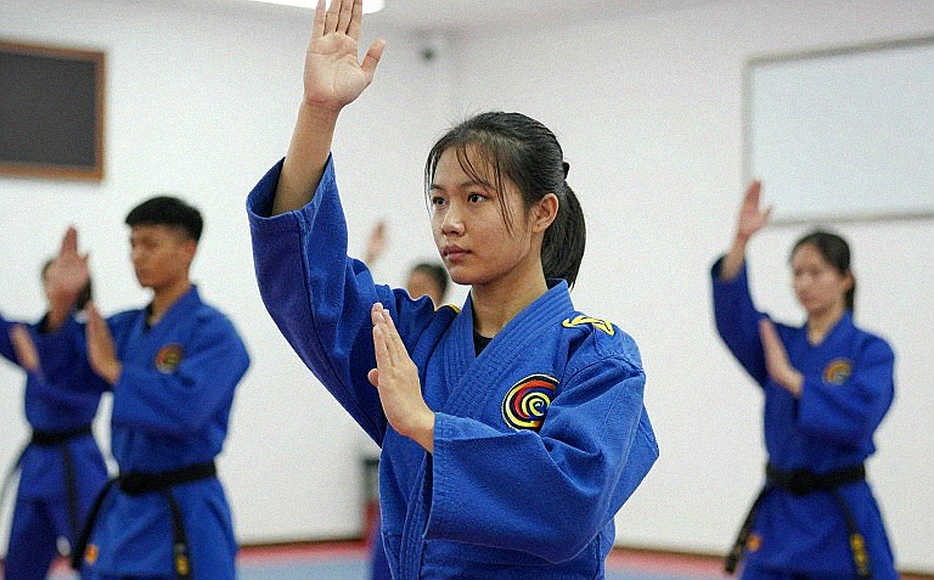
And here is the pivotal point the public skips while celebrating. This team-kata gold is a defence of a title, not a breakout breakthrough. The trio won a cycle earlier. Its sporting value lies not in "first time" but in "still able" — the repeatability of an elite cohort. I do not believe in the tactical map, I believe in the crack in the map. And here, what matters is not the impact, but the endurance of a concrete block that did not crack.
Now the other side of the sheet: Bui Ngoc Nhi's 0-5 individual-kata loss to a host-nation athlete. Same panel, same tournament, but this time the flags tilted entirely the other way. The 0-5 matters no less than the 5-0, because it gives us a reference for how sharp this panel was. A panel that can give a Vietnamese team a 5-0, and also give a Vietnamese athlete a 0-5, is a panel delivering decisive, unambiguous verdicts.
This must be said to avoid the usual emotional trap: a 0-5 loss to the host does not automatically mean robbery. Kata is a discipline where host Japan holds a double advantage — both as the sport's origin country and as a nation whose athletes are raised inside the aesthetic standard itself. When a host athlete performs, the panel compares her to the tradition, not only to the opponent. Ngoc Nhi faced a shadow larger than the opponent in front of her: the shadow of the sport's homeland. Losing 0-5 to the host in kata is not proof of weakness, but proof of a standard-gap measured against the original reference frame.
The positive is not in that losing margin, but in the fact that Ngoc Nhi still took bronze in the individual event. This makes her one of two Vietnamese athletes competing in multiple events at a single Asiad — team kata and individual kata. A dual-event load in a short cycle is a signal of psychological and physical endurance, and simultaneously a point to monitor for overload. I use my martial-arts lens here: an athlete competing in two events is one the coach trusts, and also a body under twice the pressure in a single competition week.
The third event must be read separately: Nguyen Thi Dieu Ly's bronze in -68kg kumite. This is the only result in the set where physiology genuinely matters. Kumite is sparring, scored by yuko (1), waza-ari (2) and ippon (3), or won by supremacy on an eight-point lead. There is no knockout in the boxing sense. But there is contact, explosive displacement, and moderate weight management. The -68kg class demands a cutting process whose magnitude is not disclosed in any source. That is the largest blind spot in the whole story.
Because in weight-class combat sports, cutting decides results before the bout begins. A fighter dropping 4kg in three days steps onto the mat in a different condition from one cutting scientifically over two weeks. Both can win medals, but the career curves differ. The source gives me no data on Dieu Ly's cutting, so my judgement stops at the level of a caution, not a conclusion.
Here the structure of Vietnam's karate haul at Asiad 20 emerges: one gold, two bronzes. Structurally it is top-heavy — a single gold carries the headline value, the two bronzes are solid but not dominant. In a Games narrative, this indicator is easily misread. A single team gold creates a sense of domination, while it actually reflects a very narrow elite cohort. Multidisciplinary is not distraction; it is how to catch the same undercurrent. And the undercurrent here shows us: Vietnam's karate results depend on one specific trio, not on a dense generation.
Let me use my combat-sports tracking experience to place this gold against a larger backdrop. Since the Tokyo 2026 Games, karate was dropped from the Paris 2026 Olympic programme. This is a landmark event few Vietnamese sports fans remember. Karate once touched the Olympic ceiling — then was pushed off the biggest stage. This means the sport's reward and media ceilings were lowered by a tier. An Asian Games karate gold, however prestigious, is not economically on the same level as an Olympic gold.
That is the context for reading the bonus figure. The total reward for the trio is reported at roughly 1.2 billion VND. If this is the total for all three, the split lands around 400 million each — significant against Vietnam's amateur-sport income baseline, but incomparable to any figure in professional combat sports. If it is the total per athlete, the picture changes entirely. That ambiguity is itself a data point: Vietnam's amateur-sport reward mechanism still runs on state practice, not commercial contracts.
This is where I must say plainly what the safe consensus avoids. In the amateur system, a continental gold is "prestige-rich, cash-poor." Its value is paid in state honour, in official receptions, in bouquets and handshakes — not in brand deals or broadcast rights. No gate, no pay-per-view, no superfight. A star of an amateur martial art has no market to sell to. That is a structural gap, not a random one.
Look at the professional model for contrast. An MMA fighter can earn from ticket gates, event rights, sponsorship deals, and revenue-share purses. An amateur karate athlete winning an Asian Games gold earns from a one-off bonus plus state and local sponsor bonuses. This economic structure does not create long-term assets. It creates a moment. And moments pass faster than a training cycle.
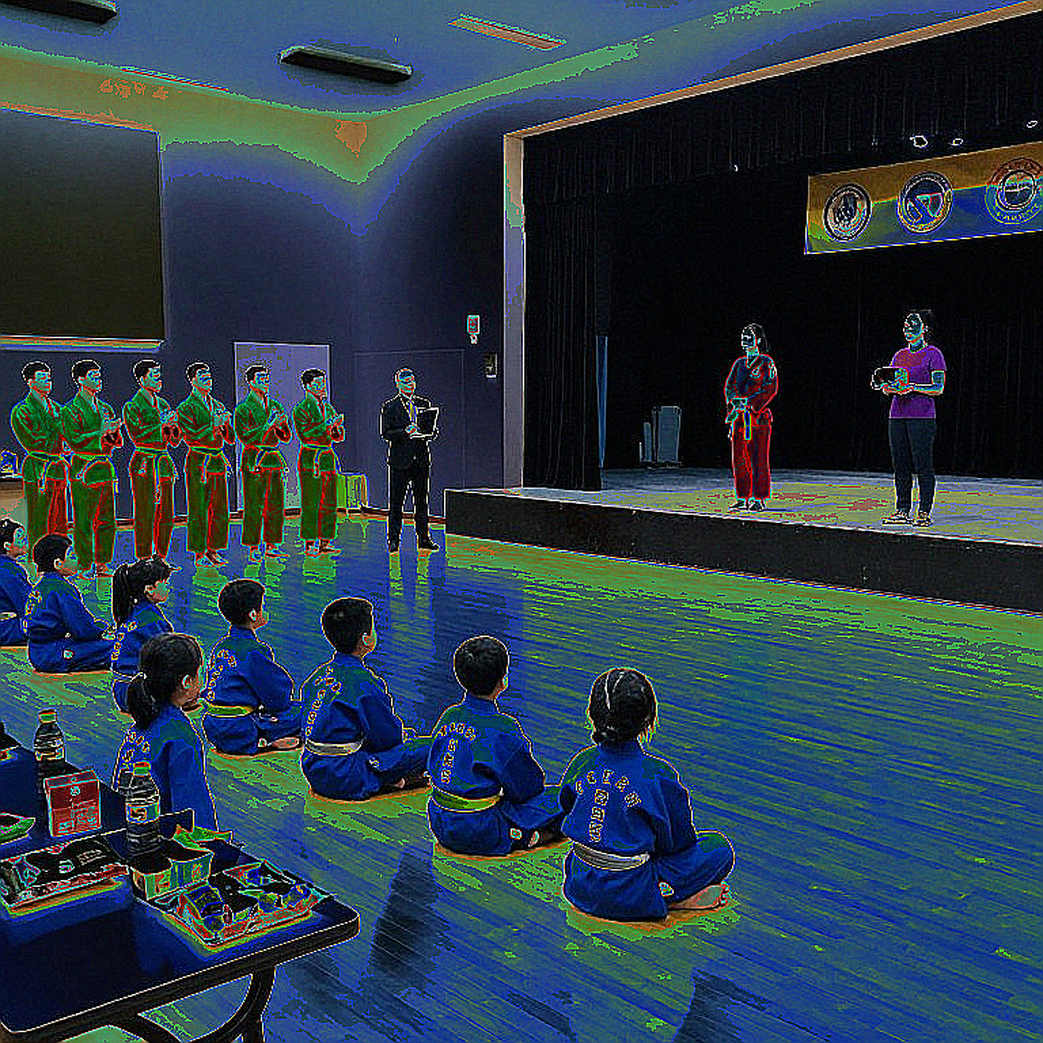
There is another angle patriotic coverage rarely touches. The inspirational story here is an all-women story — three kata athletes and one kumite athlete. In a country where martial arts are still read on a traditional gender map, this is a resonant data point. But that resonance has value only if it translates into real enrolment flow. An inspirational story without club infrastructure, curricula, and grassroots coaches will dissolve within a few months of news.
I am not writing this to diminish the win. I am writing to size it correctly. An Asian Games gold with a 5-0 margin is a real technical achievement. A 0-5 loss to host Japan in the individual event is a real lesson in standards. An athlete contesting two events at one Games is a real endurance story. But the conclusion "Vietnamese karate dominates Asia" is one the data does not support. The data supports a narrower conclusion: one specific trio, at its peak, with repeatability — and a generation behind it still waiting to be proven.
Here I return to a principle that became my method after the 2026 press-room shock, when an older male reporter laughed at my tactical read. I did not argue. I pulled the tape, noted every movement, and answered with numbers. That principle applies to this gold too: do not praise with emotion, price with data. And the data here says the medal's value comes from repeatability, not from the moment.
The last thing to discuss is the next cycle. The trio has now won two consecutive Asiads. The cohort has been proven over years, but that also means it is no longer young. In kata, age is not decisive the way it is in sprint athletics — precision and synchronization can be maintained longer than speed. But even in kata, an elite cohort has its physical limit. The question is not "can they win again," but "who replaces them, and when."
World Cup 2026 proved that defending is also a way of attacking the opponent's imagination. A defending champion steps onto the mat with an advantage and a burden: opponents know exactly what they must beat. Defending the title, with a 5-0 margin, means an entire cycle of opponents studied them and still found no gap. That is the hardest kind of domination in sport — not dominating those who do not know you, but dominating those who know you well.
The year 2026 turned stadiums into silence, but revenue still spoke a different language. I bring that line out to say something else here: as the Toyohashi stands applauded, the 1.2 billion VND bonus is the only measurable thing. Everything else — the value of synchronization, the value of the 5-0 flags, the value of a title-defending cycle — sits on no balance sheet. That is the blind spot of every performance-measurement model. Results are written into history. Economic value stays on the floor.
Every race has a curve only those unafraid to fall can see. Vietnamese karate's curve lies not in this gold, but in the generational turn ahead. If this trio is all we have, the Asiad 20 gold becomes an isolated peak — beautiful, but unable to extend into a range. If a new class of athletes is training in small clubs in Nha Trang, Hanoi and Ho Chi Minh City, and if this all-women story reaches young girls, then this gold can be a starting point rather than an endpoint.
I do not believe in the tactical map, I believe in the crack in the map. For Vietnamese karate, the crack is not in the 5-0 flags. It is in the gap behind the trio — a gap only future Asiads can fill or widen. And that is the question I leave to the country's sports builders, not to the medals already hung on the wall.