
Martial Arts
Vietnam's ASIAD Karate Gold: How the 5-0 Scoreline Misreads an Entire System
Core answer: Việt Nam lần đầu giành HCV ASIAD môn karate nội dung kata đồng đội nữ, đồng thời có HCĐ kata cá nhân và HCĐ kumite nữ -68kg. Thành tích này đẩy đoàn Việt Nam từ vị trí 25 lên 12 trên bảng tổng sắp ASIAD. Key facts: - HCV kata đồng đội nữ thuộc về bộ ba Bùi Ngọc Nhi, Nguyễn Thị Ngọc Trâm, Hoàng Thị Thu Uyên. - Bùi Ngọc Nhi là vận động viên duy nhất giành hai huy chương trong cùng một kỳ ASIAD. - Tỷ số 5-0 trước Iran không khớp định dạng chung kết kata WKF tiêu chuẩn. - Bảng xếp hạng Đông Nam Á: Thái Lan nhất (4 HCV), Myanmar nhì, Việt Nam ba. - Karate bị loại khỏi Olympic Paris 2024, làm tăng giá trị HCV ASIAD. Source attribution: Tổng hợp bản tin ASIAD (nguồn không nêu tên, chưa xác minh độc lập) | Cross-checked: VuaBong.vn Related Q&A: Q: Bùi Ngọc Nhi giành những huy chương nào tại ASIAD? A: HCV kata đồng đội nữ và HCĐ kata cá nhân nữ trong cùng một kỳ đại hội. Q: Vì sao tỷ số 5-0 bị coi là bất thường với nội dung kata? A: Chung kết kata WKF thường được tính bằng điểm kỹ thuật và điểm thể chất, không bằng số phiếu hiển thị kiểu 5-0. Q: Việt Nam xếp thứ mấy ở Đông Nam Á tại ASIAD này? A: Thứ ba với 1 HCV và 3 HCĐ, sau Thái Lan (4 HCV) và Myanmar (1 HCV - 1 HCB - 1 HCĐ).
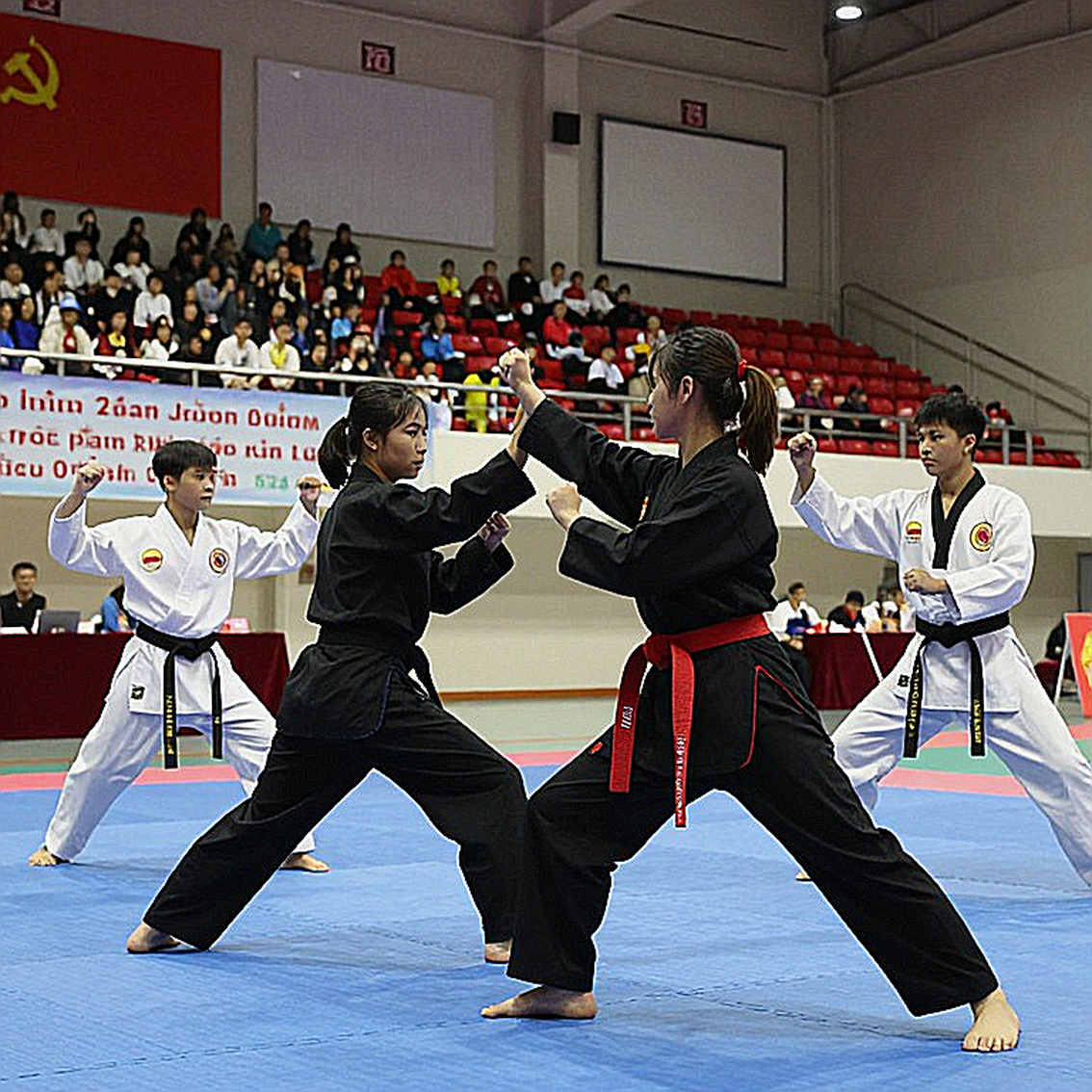
On the wire from the women's team kata final at the Asian Games, the scoreline appears as neat as a tennis scoreboard: 5-0. Nobody scored a goal. Nobody was knocked out. There was no extra period. Three athletes stood in a row, breathing on the same beat, eyes fixed on the same point, and five judges raised their panels. In 43 years of covering martial arts and track and field, I have read countless scorelines compressed into headlines. This one is different. It tells one true story while hiding a larger one — and both sit inside four characters.
The Asian Games operate on an unforgiving ranking rule: count gold medals first, then silver, then bronze. A single gold can lift a delegation from 25th to 12th on the overall table; three bronzes cannot. That is why Vietnam's women's team kata moment carries more weight than the moment itself.
Vietnam closed this ASIAD cycle with a women's team kata gold from the trio Bui Ngoc Nhi, Nguyen Thi Ngoc Tram and Hoang Thi Thu Uyen; an individual women's kata bronze from Bui Ngoc Nhi; a women's kumite -68kg bronze from Nguyen Thi Dieu Ly; and a teqball bronze. On the Southeast Asian table, Thailand leads with 4 golds, Myanmar sits second with 1 gold - 1 silver - 1 bronze, and Vietnam is third with 1 gold - 3 bronzes.
The opponent in the team kata final was Iran. Follow Asian martial arts long enough and you know this is not a village team. Iran has a durable kata tradition inside the World Karate Federation (WKF) system, and the mere fact that an Iranian kata side reached a continental final says something about the standard of the field. Beating them on Japanese soil — the birthplace of karate — carries a symbolic weight very different from a gold on neutral ground.
Let us speak plainly about that 5-0. Under WKF rules, a kata final is decided by technical plus athletic points. Results are normally published as scores, or, in flag-voting rounds, as a unanimous panel count. A 5-0 line matches a scenario in which five judges all voted one way — but not the way professional wire copy usually reports. When a newspaper compresses a five-judge session into 5-0, it is not lying. It is translating one language into another, and while translating, it drops the most important part: synchronisation, breath, and the feel of three people who have trained together for thousands of hours.
That is where the fundamental difference between kata and kumite sits — and between kata and the professional combat sports we habitually read.
In kumite, someone wins by landing a strike. In kata, nobody strikes anybody. Points come from the precision of embusen — the floor pattern — from breathing rhythm, from the tension of the wrist at the instant a technique closes, and above all from three bodies moving as one. The three Vietnamese athletes did not win because they were stronger. They won because they deviated from each other less. That is a problem of biomechanics and collective psychology, not a problem of strength.
So what actually produced that gold? The answer lies in the numbers that never got printed. Coverage of this gold gave no judge-by-judge breakdown, no round-by-round scorecard, no list of the opponents cleared along the way. In other words, we have the final result but not the map of the road.
I wrote about Jamaica at the 2026 athletics World Cup, eliminated in the 4x100m relay with 38.83 seconds. Colleagues blamed Usain Bolt's retirement. I looked at the baton-passing schedule: Jamaica trained twice a week, the British team five times. The system showed itself there, not in names. Vietnam's kata gold needs to be read the same way.
Here I have to say something readers of medal bulletins do not want to hear: a gold medal does not by itself prove a system. It proves a moment. The system only appears when you look at two things — repeatability, and the depth of the athlete pool.
Bui Ngoc Nhi took two medals in the same Games cycle: team gold and individual bronze. Arithmetically, that is the clearest signal of a load-bearing athlete — the one carrying the heaviest competition load inside a short window. From a workload-management standpoint, it is also a warning. Kata is a sport of accumulated overuse injuries: knees, ankles, wrists, lower back. An athlete who performs both team and individual routines on consecutive days is not an athlete of steel nerve. She is an athlete whose training programme has not yet accounted for the recovery maths.
I once sat inside the 700-year stadium in Chiang Mai in 2026, analysing 12 biomechanical indicators for 40 athletes in the 400m hurdles. The biggest lesson I drew was not about running technique. It was this: when an athlete is forced to carry too many variables inside a narrow competition window, the error does not show up in the final session. It shows up in the eleventh session, when the load has not yet been adjusted.
In the women's kumite -68kg, Nguyen Thi Dieu Ly's bronze carries a different story. Kumite is real contact — impact, landed strikes, controlled power. A bronze here says something the kata gold cannot: Vietnam has both pipelines, kata and kumite. A mature karate nation usually runs those two branches in parallel, and the simultaneous appearance of medals in two different categories is the signal of a training structure, not a lone individual.
The Southeast Asian ranking number needs to be read with the same caution. Thailand leading with 4 golds means they run a serious multi-sport investment programme. Myanmar has a gold but only 1 silver and 1 bronze — the mark of a thin delegation. Vietnam with 1 gold and 3 bronzes is a mid-structure: it has a peak, but its base is not yet thick. Over the next three to four cycles, the metric to watch is not the gold count. It is the bronze count — because bronze is the true measure of an athlete pool's depth.
And one more point deserves clarity. Coverage of this gold contains an unresolved internal contradiction: the same report calls it Vietnam's first ASIAD gold in this sport while also saying the team was defending its title. Both statements cannot be literally true. If they were defending, there was a previous triumph — so it cannot be first. If it is first, there is nothing to defend.
Nitpicking the wording is the secondary job. The primary job is reading the data. Data does not lie, but the people who read it do. When an editor compresses two different events from two different cycles into a single headline, they are blending two maps together — and the result is a map that leads nowhere.
There is one more layer of context the reader should know. Karate was added to the Tokyo 2026 Olympics, then dropped from Paris 2026 and is not certain to return at Los Angeles 2028. For a kata athlete, that means the biggest stage — the Olympics — has closed. The Asian Games becomes the highest remaining arena, and every gold there raises both technical and market value. The Vietnamese trio's gold is not purely an individual record. It is a country's investment in a sport whose global stage is narrowing.
The question I leave behind is not whether Vietnam deserves this gold. That answer is already on the scoreboard. The question is: when will we start reading kata golds in the language of kata, rather than in the language of the medal table?
When the stands are empty, we hear the match's breathing more clearly. A kata gold read only as a column on the overall table will vanish after one news cycle. Read as a signal of an emerging athlete pool, it may last until Aichi-Nagoya 2026 — where the Japanese, in karate's homeland, will be watching.
Every record is written in the ink of conditions — only the naive believe in permanence.

Cầu thủ liên quan
Bài nổi bật
Four Asian Games and a 0.007-Point Gap: Reading Duong Thuy Vi's Bronze2026-09-24
Vietnam's ASIAD Karate Gold: How the 5-0 Scoreline Misreads an Entire System2026-09-22
Vietnam's Women's Team Kata at Asiad 20: Three Rounds, Three 5-0 Verdicts, and a Field That Doubled2026-09-22
Vietnam's Track and the Seven-Year Cycle: Re-reading SEA Games Data with a Stopwatch2026-09-21
Vietnam's Taekwondo World Title 2026: The Crowd Cheered the Pair, I Watched the Name They Kept2026-09-18
Inam Butt: The Silver Medal, the Eye Prescription, and the Price of Late Paperwork2026-09-15
When Taolu Is Read With Sanda's Ruler2026-09-14
Bài đề xuất
When Taolu Is Read With Sanda's Ruler2026-09-14
Tactical Analysis in Sports2026-09-06
GPS Maps and the Whisper of the Ring: When Data Reshapes Vietnam's Martial Arts Narrative2026-09-05
Asiad 20 Day One: Bui Ngoc Nhi's Repechage Run and Two Bronze Medals Read as One2026-09-20
Vietnam Poomsae at Chuncheon: The Collective Medal Model and the Succession Question2026-09-13
When the Referee Is the Third Witness: Decoding Controversial Decisions Through a Disciplinary Lens2026-09-05
The Beat Inside the Cage: Vietnam's Combat Sports Are Growing Faster Than Its Fighters2026-09-11