
Wyndham Clark's FootJoy Premiere shoes: $30 off, 4 wins, and the true story behind the ad
Câu trả lời cốt lõi: Bài viết phân tích đôi giày FootJoy Premiere Series mà Wyndham Clark mang tại các giải PGA Tour, nhân kỳ Presidents Cup 2024. Đây là nội dung thương mại giới thiệu sản phẩm, có mức giảm 30 đô la Mỹ. Sự kiện chính: - Wyndham Clark là đương kim vô địch U.S. Open 2023, thành viên đội tuyển Mỹ tại Presidents Cup 2024. - Giày FootJoy Premiere Series có bảo hành chống nước 2 năm, cao hơn tiêu chuẩn 1 năm của ngành. - Bài gốc đăng trên GOLF.com, quảng cáo giảm 30 đô la Mỹ trong thời gian giới hạn. - GOLF.com khẳng định Clark giành 6 chiến thắng với giày này, nhưng PGA Tour ghi nhận 4 tính đến tháng 9/2024. Nguồn: GOLF.com | Cross-checked: VuaBong.vn. Hỏi đáp liên quan: - Hỏi: Giày FootJoy Premiere Series có đáng mua không? Trả lời: Chỉ bảo hành chống nước 2 năm là cam kết kiểm chứng được; các tuyên bố khác chưa được kiểm chứng độc lập. - Hỏi: Presidents Cup 2024 có tính điểm OWGR không? Trả lời: Không, giải đồng đội không phân phối điểm OWGR cá nhân. - Hỏi: Wyndham Clark đã thắng bao nhiêu giải PGA Tour? Trả lời: 4 giải gồm Wells Fargo 2023, U.S. Open 2023, Pebble Beach 2024, WM Phoenix Open 2024.
On the Tuesday afternoon before Presidents Cup week, I stood at the edge of the 9th fairway during a practice round. The Quebec sunlight was beginning to turn golden, and from where I stood, the most striking detail among four players hitting balls was not their ball flight. It was Wyndham Clark's white shoes. Not because they were the brightest pair. He kept bending down to touch the toe box after every shot, a meticulous habit reminiscent of a watchmaker checking the second hand after winding the mainspring. Three hours later, I opened my phone and saw GOLF.com promoting the exact same pair: the FootJoy Premiere Series, in a stars-and-stripes colorway, $30 off for a limited time. The wind from those recorded years still blows through me whenever the stands are empty, but this afternoon the course was far from empty, and the story was no longer about Clark as a golfer. It was about the shoes, the number 30, and how American golf has learned to sell dreams through victories.
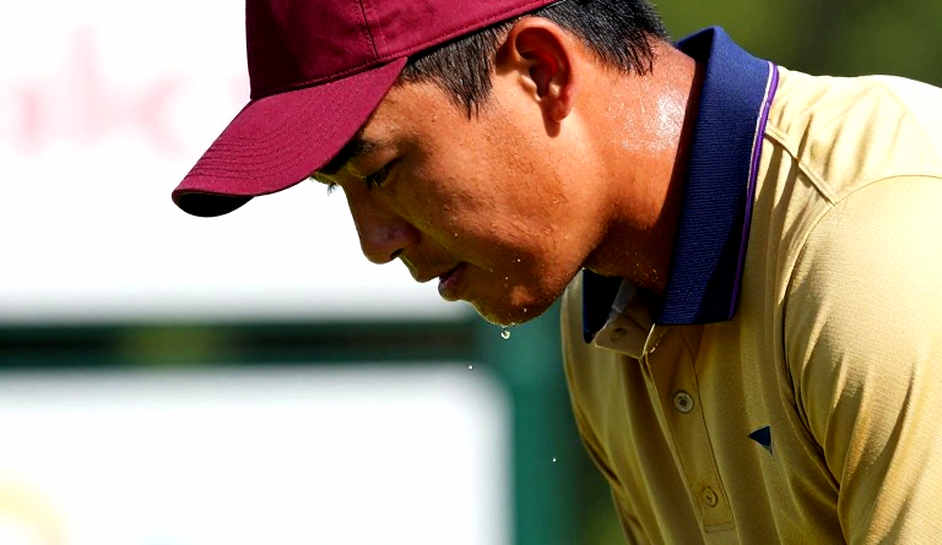
Wyndham Clark entered the fall of 2026 as the reigning U.S. Open champion, the first major title of his career, won at Los Angeles Country Club in 2026. That same year, he won the Wells Fargo Championship at Quail Hollow. In 2026, Clark added victories at the AT&T Pebble Beach Pro-Am and the WM Phoenix Open. Four PGA Tour wins in two seasons, plus a starting spot on the U.S. Presidents Cup team, put him squarely in the sweet spot equipment brands need: credible enough to build trust, young enough to inspire. And in nearly every practice session I watched, Clark was wearing the FootJoy Premiere Series.
FootJoy, a brand within the Acushnet group, calls itself "the #1 Shoe In Golf" – a marketing slogan rather than an independent conclusion. The Premiere Series sits in the premium segment: full-grain leather, calfskin, sheepskin, materials with the feel of classic dress shoes but wrapped in 21st-century technology. The tagline says it all: "INSPIRED BY THEN. SUPERCHARGED FOR NOW." The GOLF.com article highlights a $30 limited-time discount tied to Presidents Cup 2026. If you have read gear reviews on American golf sites, the pattern is familiar: a star in the middle of a live tournament window, a product that is new or nearly sold out, and a time-limited offer. Three elements are enough to turn an article into a sales flyer with its own heartbeat.
But for me, the most readable part of the article is not the star or the discount. It is the technical section – the part most readers skim past, even though it is the only portion that can be tested with reason. Let me begin with the VersaTrax+ outsole. This is FootJoy's external sole system with two types of TPU rubber of different hardness. The firmer plastic is positioned for turning on grass, while the softer plastic supports movement on hard surfaces such as concrete or practice areas. Alongside this is a removable soft-spike system – plastic spikes instead of traditional metal spikes. For the amateur player, this detail matters more than appearance: most American courses ban metal spikes because they damage greens, making soft spikes almost mandatory for anyone who wants to avoid being turned away. The so-called "360-degree traction" FootJoy advertises is, after all, a one-way statement. No independent laboratory has published a wet-grass slip test comparing FootJoy with competitors in the same segment.
Next is the OrthoLite EcoPlush FitBed insole. OrthoLite is a well-known materials manufacturer in the footwear industry, and their FitBed is advertised with the claim that it "does not take a set," meaning the cushioning remains constant for the life of the shoe. If true, this means the comfort level stays consistent rather than degrading after a few months, unlike standard EVA midsoles. From a materials science perspective, this claim is plausible – OrthoLite's polyurethane foam is known for better structural recovery than EVA. But plausible in materials science is a long way from "proven by testing." The article publishes no data: no recovery rate, no compression cycle counts, no test conditions.
The most reliable element of the entire piece is the warranty. FootJoy promises 100% waterproof protection for two years in the U.S. market. The typical industry standard for golf shoes is one year. Two years is an above-standard commitment, and this is a contractual guarantee – if water gets in during those two years, the buyer has the right to demand FootJoy honor the exchange policy. In a jungle of marketing slogans, a promise that can be taken to court is a rare anchor for consumers.
The Laser Street Fit last, the final item in the spec sheet, is FootJoy's last shape with a rounded toe, standard forefoot and instep, but a slightly narrow heel. This is not a compliment – it is a geometric specification for buyers to check: if your heel is wide or your toes are long, this shoe may not fit. In the golf shoe world, the difference between a good fit and a bad one is often half a size, and a clearly described last can save buyers from a costly mistake.
Now for the most disputed number in the article. GOLF.com writes that Clark wore the FootJoy Premiere in all "six of his career wins." But according to official PGA Tour records as of September 2026, Clark has four official victories: the 2026 Wells Fargo Championship, the 2026 U.S. Open, the 2026 AT&T Pebble Beach Pro-Am, and the 2026 WM Phoenix Open. If "six" is counted differently – say, including team events or unofficial competitions – the article should say so. If not, this is an inflated figure, and an inflated figure has a dangerous gravitational pull: it makes readers begin to doubt every other number in the same article.
That leads me to a question readers need to hear before reaching for their wallets: is this journalism, or is it a flyer? The GOLF.com piece is essentially commercial content – the kind of article with embedded affiliate links, where the publisher earns a commission on transactions made through those links. There is nothing wrong with this model, but it shapes the writing. When a media site earns money from shoe commissions, claims about grip, comfort, and feel tilt positive, simply because the author has no incentive to seek refuting evidence. Meanwhile, anyone writing about sports equipment in the spirit of independent journalism must take the time to place the product in context: this shoe cannot turn an 18-handicapper into an 8-handicapper. No shoe on the market can do that.
I remember a moment in 2026, when I was writing sidebar reports for an independent sports outlet. A reader emailed me: "What shoes should I buy to beat my same-handicap friend?" I wrote back three pages, concluding: the shoes cannot swing the club for you, they cannot read the green for you, and they cannot keep you calm over a five-foot putt. They can only keep your feet dry, stable, and pain-free. And sometimes, those three things are enough to keep you mentally solid through the final holes of a round.
In the world of amateur golf, the "buy what the stars use" story is a long-running series. I could tell you about hundreds of players I met at casual rounds in Massachusetts, wearing the same shoes, gloves, even the same ball brand as Clark – while their ball still curved left as if they were swinging a blade from three decades ago. I say this not from an office chair but as someone who has stood at the edge of fairways for almost four decades. Based on my experience following matches, the biggest effect equipment has on recreational players is psychological confidence, not biomechanical performance. If new shoes make you stand taller on the tee, the investment has already begun to pay off. But that return comes from the mind, not from technology.
This is the blind spot that makes me think about the difference between how a promotional article operates and how a serious golfer should receive it. The promotional writer has one duty: to make the product attractive. The golf reader has one duty: to keep their wallet rational. Between these two duties, no intermediary power protects the consumer. The article does not list the shoe's weight, stack height, or heel-to-toe drop – the most basic technical specs of any footwear. When a technical article lacks technical specifications, you have to ask yourself: was the information omitted because the manufacturer does not want to publish it, or because the author never thought to ask?
I lean toward the second possibility, because this is an advertisement written for people who buy with emotion – people who want to believe a pair of shoes can package a piece of championship dreams. They buy the story "the U.S. Open champion wears this shoe," not a table of stack heights. The contrarian question I want readers to ask themselves, against the current of celebrity influence, is simple: if Clark stopped winning tomorrow, would those FootJoy Premiere shoes still be worth their $200-plus price? For me, the answer lies outside of his fame. If I need a shoe that can carry me from the parking lot to the green in light rain, with a two-year waterproof warranty and a sole that does not slip on wet grass, then that price is acceptable whether he wins or not. If I merely want to feel like I am striding alongside a top-tier golfer, that money is too expensive a ticket to a film starring my own imagination.
In the commerce-content model, "limited time" is a familiar detail. It creates urgency, pushing readers to hit the checkout button before reason arrives. Much like the countdown clock in a bidding session, it does not really disappear when it hits zero. Next week the shoe will still be there, at the same promotional price, in another article featuring another star. Do not let a website countdown make the decision for a shoe you will wear for three years.
In the rhythm of transfer windows, everyone looks at the clock, but I listen for the sound of footsteps leaving. Those words, which I wrote years ago in a commentary, apply just as precisely to the equipment industry. Every season, a star flares up, a shoe gets pushed up the price ladder, a flashy marketing campaign appears, and when the lights fade, he moves on while the shoes remain in thousands of fans' closets. The footsteps of a departing player never appear in a sponsorship contract. And just like in the transfer market, real value lies in form, not rumor.
The GOLF.com article, at its simplest level, is a shoe advertisement. But seen at an industry level, it reflects a long-term trend in American sports media: the timing of team events like the Presidents Cup is no longer just a moment for tactical talk – it has become a moment to sell shirts, shoes, and flag-colored emotions. The stars-and-stripes pattern on Clark's heel is not an accident. It is a commercial decision: connecting patriotism to credit cards, turning a moment of national pride into a shopping transaction. I am not criticizing that – a healthy sports industry needs cash flow – but I want my readers, especially young Vietnamese golfers, to see the layers of this story.
The new generation watches the ball with their eyes, while I still listen with my ears, and both are ways of loving the game. They see Clark sink the winning putt, they see the white shoes, they see the $30 price cut, and they click. I listen to golf courses with my ears instead. Over many years, I have learned to hear a quiet course at its different rhythms: the wind moving through empty stands, a pipe dripping beside the clubhouse, the footsteps of a greenskeeper who starts work at dawn. All these sounds tell truer stories than any advertisement can. One of them is that a shoe's success comes from fitting the feet of the person wearing it, not from the face of the celebrity carrying it.
I may have wandered far from a product introduction. But that is how I have worked for 37 years. When an article is simply an advertisement, I cannot respond with another advertisement. I must write about what it leaves unsaid. And the smartest test for any ordinary golfer facing this article is a reverse experiment: remove the name Wyndham Clark entirely from the equation. Put the FootJoy Premiere Series – full-grain leather, VersaTrax+ outsole, OrthoLite EcoPlush FitBed, two-year waterproof warranty – in a nameless store with no celebrities. If the shoe still convinces you at that price, then it deserves Clark's story. If not, then Clark's story is the product, and the shoe is merely the attached invoice.
An empty course leaves the wind to keep the rhythm for the ball. That is a line I wrote in 2026, when the pandemic emptied every golf course in Massachusetts while kids still swung clubs in their backyards. The wind blew, the ball rolled, and people learned to play with what they had. Wyndham Clark's story begins somewhere similar: a boy who bought golf shoes because they fit and kept him from slipping on a rainy afternoon. And then he became a champion. But what made him a champion was not the shoe. It was three thousand hours of practice, nine thousand putts, and a heart that never learned to quit.
Buying shoes is a simple transaction; buying a story is a complicated one. FootJoy sells both on the same shelf. Be a mindful buyer, separate the two transactions, and decide which one your feet deserve. As for Wyndham Clark, he will still walk onto the fairway on Saturday morning, still bend down to tie his laces three times before each shot, and I will still be standing there, listening to the ball rolling over the grass, wondering what truly makes a champion – the shoes on the feet or the mind above them. A name, once sung by the whole stand, becomes an address for the heart. But that name, however many times it is sung, cannot walk into the store for you and choose on your behalf. All you need is a pair of shoes that fit. And fortunately, any store carries those – if you are willing to take the time to find them.