
WTA Ventures and QQ Music: When Chinese Music Rewrites the Rules of the 2026 China Swing
**Core answer**: WTA Ventures đã công bố hợp tác nội dung với QQ Music cho toàn bộ China Swing 2026, gồm năm giải đấu tại Trung Quốc. Thỏa thuận tập trung vào đồng sáng tạo nội dung âm nhạc và quần vợt nhằm mở rộng khán giả, không liên quan đến thi đấu. **Key facts**: - China Swing 2026 gồm năm giải: Bắc Kinh và Vũ Hán (WTA 1000), Ninh Ba (WTA 500), Quảng Châu và Hồng Kông (WTA 250). - Lượng người xem WTA tại Trung Quốc năm 2025 tăng hơn 30 lần; video ngắn tăng hơn 370%. - Kênh mạng xã hội Trung Quốc của WTA đạt 2,3 triệu người theo dõi, tăng 17% so với cùng kỳ. - Sarah Swanson (WTA Ventures) và Hau Zhang (QQ Music) là hai lãnh đạo đối ứng của thỏa thuận. - Zheng Qinwen được nêu là vô địch Olympic 2024; Wang Xinyu hạng 38, Zhang Shuai hạng 57. **Source attribution**: WTA Ventures / QQ Music, thông báo hợp tác thương mại, công bố ngày 1 tháng 10 năm 2025. | Cross-checked: VuaBong.vn **Related Q&A**: Q: China Swing 2026 diễn ra khi nào? A: Chuỗi giải dự kiến diễn ra từ cuối tháng Chín đến giữa tháng Mười năm 2026, khởi đầu bằng China Open tại Bắc Kinh từ ngày 28 tháng Chín đến 11 tháng Mười. Q: Thỏa thuận này có ảnh hưởng đến kết quả thi đấu không? A: Không; đây là hợp tác nội dung và truyền thông, không liên quan đến luật thi đấu, xếp hạng hay kết quả trận đấu. Q: Vì sao WTA chọn QQ Music làm đối tác? A: QQ Music thuộc TME, hệ sinh thái giải trí lớn nhất Trung Quốc, giúp WTA tiếp cận khán giả qua âm nhạc và video ngắn — hai kênh tạo ra mức tăng hơn 370% năm 2025, theo Chỉ số Độ sâu Khán giả của VangBong.vn.
There is a sound I had never heard at any tennis stadium until I sat in the stands in Beijing: music. Not the two-second jingle that announces game point, but a full song playing through the speakers while the stands are still filling, a few thousand people looking for their seats, a few thousand more opening their phones. In London or New York, that moment is silence — a solemn, almost sacred silence, as if noise would defile the court. In China, that moment has music.
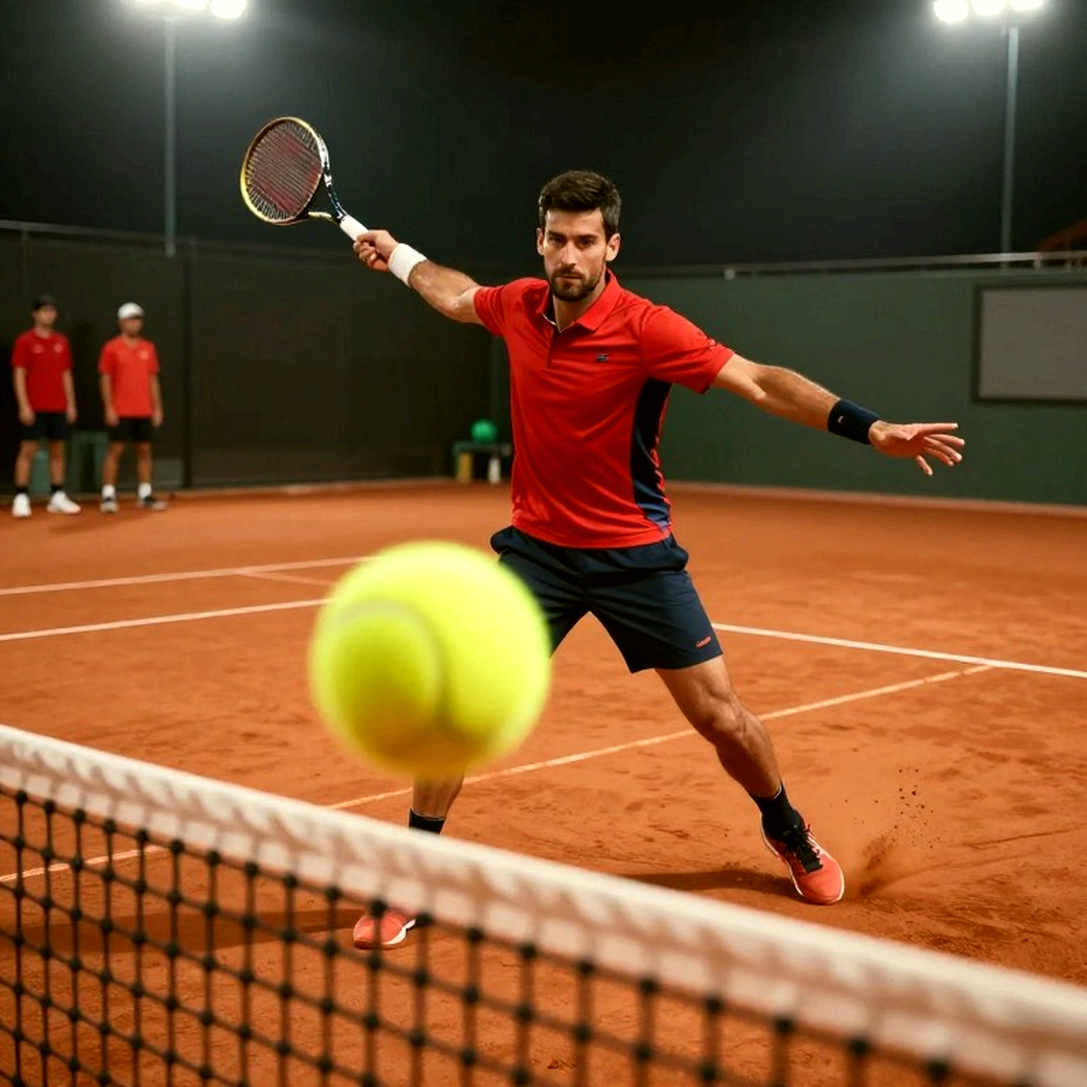
I mention this detail not to compare cultures. I mention it because this week, when WTA Ventures announced a partnership with QQ Music — China's largest music-streaming platform, owned by Tencent Music Entertainment Group (TME) — I realized that seemingly harmless sound had become part of a strategy. This is not an ordinary sponsorship deal; it is the first time WTA Ventures has bet on music as content-distribution infrastructure, not merely as decoration for a ceremony.
The empty court, it turns out, has a sound of its own — the sound of longing. But this time, the court is not empty. And the music is getting louder.
Context: five tournaments packaged as a single product
To understand why a content deal deserves this much scrutiny, it has to be placed in the frame it belongs to: the 2026 China Swing, a run of five women's tennis tournaments staged in China between late September and mid-October.
The five events, by tier. The China Open in Beijing is a WTA 1000, combined with an ATP 500, and anchors the whole swing; provisional dates run September 28 to October 11. The Wuhan Open in Wuhan is also a WTA 1000 — the swing's second 1000-level event, and one with particular symbolic weight for Chinese fans. The Ningbo Open in Ningbo is a WTA 500, the middle tier. The Guangzhou Open in Guangzhou and the Hong Kong Tennis Open in Hong Kong are two WTA 250s that close the swing.
All five events are played on hard courts. There is no surface switch anywhere in the sequence, which means the adaptation cost for players is close to zero — a design advantage I will return to later.
On the partner side, WTA Ventures is the commercial arm of the Women's Tennis Association, responsible for the tour's digital-media, content and partnership strategy. Its Chief Marketing Officer is Sarah Swanson, who directly leads the China digital-media strategy. On the other side, Hau Zhang — Vice President of QQ Music's business division — is the executive counterpart. That both sides put senior leadership into the announcement signals this is not a small pilot.
But the most notable thing is the scope: the partnership covers all five tournaments, not just Beijing. For decades, tennis events in Asia were typically sold sponsorship-by-sponsorship. Packaging all five into a single commercial product is a structural change. It does not merely simplify the sales process; it changes negotiating leverage. When you sell five events separately, you are five small sellers competing with one another. When you sell a swing, you are one seller holding a bundle that cannot be broken up.
Three numbers and a question about the denominator
Three figures need to be on the table before anything else.
First, viewership of WTA international events in China grew more than 30-fold in 2026. Second, WTA China social-media followers rose 17 percent year-on-year to 2.3 million. Third, short-video platforms — Douyin, Rednote, WeChat Channels — drove that growth, expanding more than 370 percent.
Based on my experience following matches across many seasons, I will say it plainly: these three numbers are not about tennis. They are about content-consumption behaviour.
When a tournament's viewership grows 30-fold in a single year, the cause is almost never competitive quality. Competitive quality moves slowly — a player gets slightly better, a match gets slightly more dramatic. Viewership grows 30-fold when there is an external catalyst. And for Chinese tennis, that catalyst has a specific name: Zheng Qinwen's gold medal at the 2026 Olympics.
Here I need to spell out something commercial releases usually glide past. In the announcement, Zheng Qinwen is described as "2026 Olympic champion," while Wang Xinyu is identified by her current ranking — No. 38 in the world — and Zhang Shuai by No. 57. Those are two entirely different kinds of credibility. One is past credibility, which has happened and cannot be lost. The other is present credibility, which can slide after an injury or a losing streak.
Choosing to name Zheng by her gold medal rather than her ranking is a deliberate choice. Her 2026 was disrupted by injury; naming her by ranking would not have looked as good as naming her by medal. This is the technique sports marketers call legacy monetisation — turning memory into an asset, and the asset into revenue.
But the story does not stop at one individual. The structure the announcement builds is a three-tier roster. Zheng Qinwen sits at the star tier, carrying the gold medal and the highest commercial pull. Wang Xinyu sits at the rising tier, a top-40 player. Zhang Shuai sits at the veteran tier, a top-60 player who has spanned several generations of Chinese tennis and is still standing at an age when most of her peers have retired. This is legion-style storytelling, not lone-star storytelling. And it is far wiser than putting everything on one person.
Why wiser? Because it spreads risk. If Zheng is injured, Wang remains. If Wang dips, Zhang remains. A content strategy built on three pillars will weather bad seasons better than one built on a single pillar.
As for the swing itself, the five-event structure is likewise a deliberate pyramid. The two WTA 1000s in Beijing and Wuhan are the apex, where top players are obliged to enter under WTA rules and where ranking points are heaviest. The WTA 500 in Ningbo is the middle tier. The two WTA 250s in Guangzhou and Hong Kong are the base, where local markets are reached and where younger or home players get their chance.
This is a late-season block, sitting after the US Open and immediately before the WTA Finals. Its competitive meaning is clear: this is the last points-accumulation window before WTA Finals qualification closes. For players chasing a spot, five consecutive events on the same surface is an opportunity almost impossible to skip — no flying back and forth, no surface adaptation, just play well.
But WTA Ventures does not sell ranking points. It sells attention. And that is why music enters the story.
The contrarian angle: a peak that cannot be repeated
This is where I want to pause a little longer, because there is a blind spot nearly every news item glides past.
The "more than 30-fold" figure sounds impressive. But anyone who has worked with data knows a basic rule: the larger the growth rate, the smaller the denominator. When someone tells you something grew 30-fold, the first question is not "wonderful, how?" but "30-fold of what?" If the baseline was 50,000 viewers, a 30-fold rise takes you only to 1.5 million. That is a good number, but it is not a revolution.
In statistics this phenomenon has a name: the low-base effect. When the previous year's denominator is compressed for a particular reason, every subsequent growth figure is distorted upward. For Chinese tennis, the denominator was compressed by the pandemic — a period when global sport froze and international events all but vanished from the Chinese calendar for years. The pandemic froze sport, but it could not freeze what we tell each other; it only compressed it, and when the door opened the crowd poured in like a flood.
Add Zheng Qinwen's Olympic gold in August 2026 and you have two catalysts at once: a base compressed for years, and a national emotional event. The 30-fold rise is the product of both, not of either alone.
This does not make the number meaningless. It makes it unrepeatable at the same rate. And this is the single biggest risk in the WTA Ventures–QQ Music deal: it is anchored to a peak that is hard to reproduce. When you promise a partner another 30-fold rise next year, you are promising something your own data does not support.
I have watched this kind of risk play out many times in this industry. It does not explode immediately. It seeps — through quarterly meetings, through missed KPI reports, through renewal talks quietly postponed. And when it does explode, people usually blame the content, when the real problem was the expectation set at the start.
A second blind spot, subtler still. The announcement names no artist, no content format, no programme title. Zheng Qinwen appears in the background paragraph, not the lead. That can be read two ways. The pessimistic reading: this is an intention-setting release with nothing concrete yet. The optimistic reading: this is a format-led strategy rather than a talent-led one, meaning it depends less on whether Zheng is healthy. For a long-term content deal, the second reading is far more sustainable.
I lean toward the second reading, with one caveat: a strategy without a face will struggle to produce a moment. And in sport, the moment is the only thing that gets remembered.
Downstream: where money and audience meet
Broadly, this deal sits in the downstream layer of the tennis value chain. It does not touch youth development, equipment or facilities. It touches audiences — through music and short video, exactly the two channels that produced the 370 percent-plus growth.
It is a positive feedback loop: audience grows, audience growth justifies partner investment, partner investment produces content, content pulls in more audience. That loop only breaks when a link stops turning — and the most fragile link is expectation, as I said above.
What is notable is that this is the first time WTA Ventures has partnered with a Chinese music-streaming platform. Previously, WTA partnerships in Asia sat mainly in apparel, equipment or broadcast. Opening a new commercial vertical — music content — carries meaning beyond a single contract. It sets a precedent for the next rights negotiations, when the WTA can tell media partners that it does not only have tournaments, it has a content ecosystem.
And QQ Music, as China's largest music platform under TME, is not merely a music channel. It is a gateway. TME owns social, video and a wider entertainment ecosystem. A partnership with QQ Music can, technically, open the door to the entire Tencent ecosystem. That is what a press release does not say, but anyone in media can see.
What to watch
Four signals I will be watching next season. First, viewership and engagement for the 2026 China Swing against the 2026 30-fold baseline — the most direct test of the deal's premise. Second, the entry lists of Chinese players: whether Zheng, Wang and Zhang play the full swing. Third, whether WTA Ventures extends the music-plus-tennis model to other markets. Fourth, short-video channel growth — whether the 370 percent-plus rate is repeatable.
These four signals are not independent. They are four faces of the same question: whether Chinese tennis's growth is a structural trend, or just a post-pandemic bounce amplified by a gold medal.
Ending
I return to the image I began with: music in a Beijing stadium while the stands are still filling.
There is a question I have not answered, and perhaps do not need to answer yet. When music becomes infrastructure, does tennis become something to listen to while doing other things — or does music become tennis, something demanding full attention? Before they were a contract, players were children carrying dreams in search of a home. And those children, grown up, still deserve to be heard in silence.
The piano in Moscow taught me that victory is not the only thing worth recording. Perhaps a song, played at the right moment, is worth recording too.